Showing posts with label 6 - Teaching+Judy-Anne. Show all posts

16 November 2019

TBCS - Deliberate Acts of Teaching - Judy-Anne


Instructional strategies are the tools of effective practice. They are the deliberate acts of teaching that focus learning in order to meet a particular purpose. Instructional strategies are effective only when they impact positively on students’ learning.
Effective Literacy Practice in Years 5 to 8, p. 78
Teachers need to be able to use a range of deliberate acts of teaching in flexible and integrated ways within literacy-learning activities to meet the diverse literacy learning needs of our students.

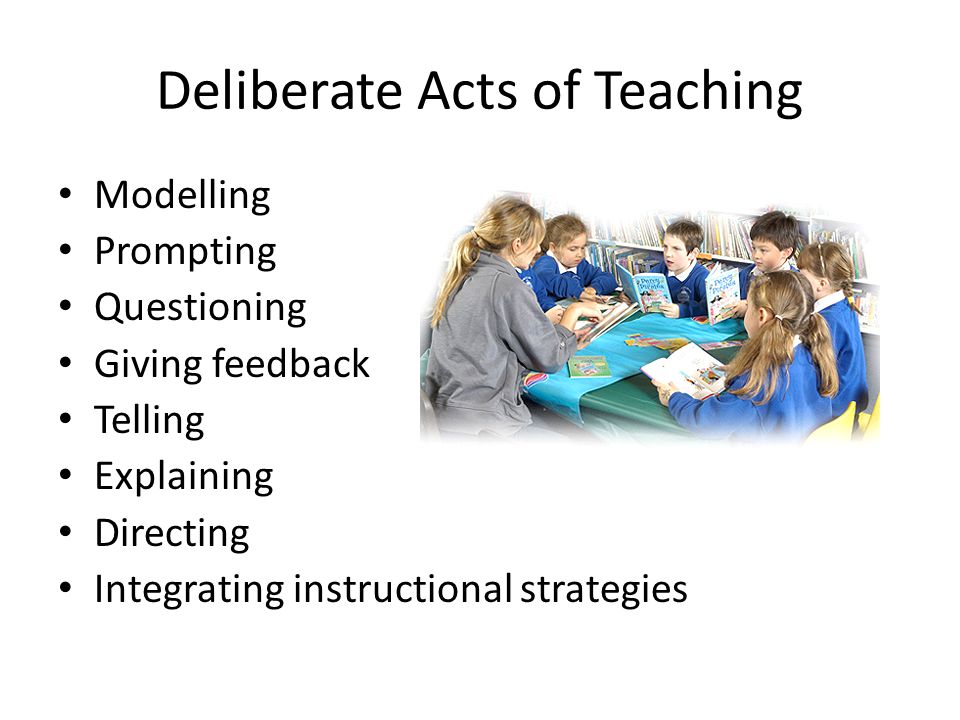
Deliberate Acts of Teaching


Apparently ERO feels we weren't able to show that we were teaching our children, and were too reliant on a use of technology to do so.
Therefore somehow we need to get better at showing what it is that we actually do!


I checked to see what were classified as 'Deliberate Acts of Teaching.'
Sometimes you just need to use the right jargon. This is something I have tried to avoid throughout my career as I have seen a number of people use jargon as a weapon to show that they know more than others. My pet peeve is 'pedagogy!' I would much rather say things in a way that everybody can understand- isn't that why we are supposed to write plain English, easy to understand reports?

Pedagogy: - 

What is Pedagogy?

Pedagogy is defined simply as the method, and practice, of teaching. It encompasses: 
When people talk about the pedagogy of teaching, they will be referring to the way teachers deliver the content of the curriculum to a class.


My challenge is not using the Deliberate Acts of Teaching (I hope!) so much as it is in recording them.

To help I think I will print out the list of deliberate acts of teaching and store them at the front of my planner.
I also need to add those specific words to some generic, as well as specific plans eg handwriting and phonics will include modelling and feedback
Maybe the words can be highlighted or colour coded and specific questions I am planning to use, or do actually use can be recorded in a regular fashion, whether daily, weekly, per lesson type...

Next steps:
. Print deliberate acts of teaching and put in planner
. Record at least one deliberate act of teaching in planner each week, increasing frequency as it becomes a habit
. Aim to complete the daily class journal daily!
I also found a great lesson plan about simple sentences which outlines DATS through out


  • Use of inquiry to inform planning and teaching.
  • Checking to see if planning and delivery of programme is tailored to the strengths, needs and interests of ākonga.
  • Using appropriate pedagogies to accelerate progress of ākonga who are achieving below national expectations

9 November 2019

TBCS - Decodable Texts - Judy-Anne


Inquiry:

So I had been seeing posts on Facebook pages about decodable texts and how amazing they are but didn't know what they were or why they were so great, and I also wasn't sure how to get new resources with an empty money pot!

I did a little research on them today and discovered they are phonics based. There are heaps of free ones available, some online and some that you can print but looking at them I realise we have some of them sitting in the back room as well. What a bonus!

I am wondering whether increasing use of phonics and decodable texts will help my youngest boys with their reading at a more accelerated pace.

Action Plan:

. Set up the phonics song on the sample student on seesaw so they can access it for themselves more readily
. use decodable texts with Samuel, Beauden, William and Elijah
.continue to work on blends with the whole class


Chalking on Blogger

Decodable books


  • Undertaking PLD and further professional reading.
  • Engaging with school-wide inquiry approaches as expected.


  • Use of inquiry to inform planning and teaching.
  • Checking to see if planning and delivery of programme is tailored to the strengths, needs and interests of ākonga.
  • Using appropriate pedagogies to accelerate progress of ākonga who are achieving below national expectations.

28 May 2019

TBCS - New student - Judy-Anne


There is a new entrant in Room 1 and at the beginning he settled into class extremely well and was great with listening and following instructions.
I feel now as though the honeymoon period is over and don’t feel I am doing very well with him.
I have been thinking about what to do about him and came up with some ideas while I was at Sally Clendon’s Literacy course.

Reflections:
It is quite difficult with one child starting in class by themselves. There is nobody else his age and they are all little and not always great at including new people. (egocentric)

Next steps:
.Find out his interests a bit more - things were a bit different with his transition so this wasn't really done as well as usual. We do know that he likes blocks!
. Let him play with the blocks outside so it doesn’t matter so much if he wants to knock them down while others are working
. Get a better supply of books just for him
. Print some books from Tar Heel reader for him
. Let him play more
. Make sure the others are including him
. Set up activities so that it is a good thing to be teamed up with him

The funniest thing about this is that on the first day back after the course I organised for this child to use one of the magnetic mazes for handwriting, not expecting him to do his handwriting in his book- but he used his book and handed it in like everyone else.
I had got him a big pile of library books, and made some sheets for him to practise writing his name and make his name with plasticine, pipe cleaners and magnetic letters. He sat at the table, read a book, put it in a pile of books he had read, then read another and another. He stayed at his desk rather than wandering the classroom as he had been doing.  He did a fantastic job of tracing his name- even other children couldn't believe how neatly he had written.
He had other children asking if they could come and read some of his books and use his plasticine too.
He sat beautifully when I called him over for memory verse testing and informed me that he had been tricking me when he was wandering around and bothering others in the class.

I told the class that I was so pleased with him that they could all have some free time. They were very pleased with him and he asked if he could go back and do his work, so went back to reading books. He did eventually change this to making a huge block tower.

I gave him a certificate for his fantastic work.

Day 2 and he is still working really well and very keen to be doing his work.

We haven't even got onto trying some of the items on my list yet!


  • Involvement in appropriate PLD.
  • Discussing my practice with colleagues and being open to new ideas.


  • Personalising learning and making it meaningful for individual ākonga.
  • Engaging appropriately with ākonga so they know their perspectives are listened to and considered.


  • Engagement with subject associations, PLCs, local experts and community organisations.
  • Identification of next steps and goals for ākonga.

10 May 2019

TBCS - Maths Buddy - Judy-Anne

I’m not quite sure what made me think of it but I have been thinking of ways to use more technology in the class again. Craig is often talking about how well his children are progressing on Maths Buddy and I finally realised that we didn’t need to have licenses for everybody in the class!
We have started using year groups, watching the videos and answering the questions together. They have generally been pleased about how easy they were finding the questions. Rounding to the nearest hundred was tricky for the year 3’s though.

Reflection:
One of the advantages is that the videos are playing out loud so everybody can hear every lesson, they can choose to join different lessons if they like and I can also require children to watch a different level video, particularly if they found their level difficult. Some of them will be able to move up to the next level quickly.


Next Steps:
. Set some extra practice for rounding to the nearest hundred for the year 3’s, except luca who was very confident.

Standard 6 Teaching

Use an increasing repertoire of teaching strategies, approaches, learning activities, technologies and assessment for learning strategies and modify these in response to the needs of individuals and groups of learners.

Teach in ways which enable learners to learn from one another, to collaborate, to self-regulate, and to develop agency over their learning.

  • Monitoring of ākonga learning during the implementation of a programme of learning, so that the programme can be adapted where needed to better achieve desired outcomes for ākonga.

6 May 2019

TBCS - Lessons from Life Education - Judy-Anne


It is always lovely having Ingrid visiting. While I sometimes think she has a fabulous job I am not sure I would like (or cope well with) having a number of  different classes and levels in a day and even potentially a number of schools in a week. She also gets to be observed for every lesson - ugh. Plus she gets to play second fiddle to a puppet!
Life Education has lots of resources to share so there always plenty of options for follow up work.
Ingrid uses lots of many positive teaching methods. She makes the rules fun- eg put up your brain aerial if you want to speak, but also sets very firm boundaries. She gives clear directions and checks they are understood. Everybody gets a chance to shine. The children are engaged by the activities, the songs and of course they adore Harold. William in particular loved the science and knew which way up to put the snorkel.
The children enjoyed telling me how they had swum underwater with Harold on Friday and the room was all blue. There is some great technology in that truck!


Reflections:
Ingrid was very good about involving everyone, getting them up and moving and using songs. While I do all those things maybe I should keep a bit more of a record to ensure I am doing it regularly. Maybe I include some children more than others and we probably don't move and sing as regularly as they did with Ingrid. Maybe the question is 'how much movement and singing do they need?' If they are happy and on task are they getting enough?

Next steps:
. Get the puppets out
. Ensure we follow up on some of the learning from our sessions. Check with the children and also check back to Ingrid's lesson plan for Friday as I was away sick.
.Complete at least some of the work books at school
.Make thank you cards
. Art work about Harold swimming underwater
.Maybe write a story about Harold's visit to Kelly Tarlton's, and use of the snorkel to breather underwater
vocab list- respiration, oxygen, carbon dioxide, lungs, trachea, mouth and nose


3. Engage in reciprocal, collaborative learning-focused relationships with:
·         learners’, family and whānau
·         teaching colleagues, support staff and other professionals
·         agencies, groups and individuals in the community.
  • Appropriate and professional communication with colleagues, ākonga and whānau.

6. Use an increasing repertoire of teaching strategies, approaches, learning activities, technologies and assessment for learning strategies and modify these in response to the needs of individuals and groups of learners.

Provide opportunities and support for learners to engage with, practise and apply learning to different contexts and make connections with prior learning.

  • Observing other teachers’ use of resources and teaching strategies.

14 November 2018

TBCS - PRT Programme - Judy-Anne


I finally got around to sorting through the Provisionally Registered teachers paperwork we had at school. Managed to get it down from one box to 2 folders, plus one folder of an outline from the Education Council to check. I discovered that lots of the good stuff which was in the TBCS folder was actually from templates from the Education Council. Good thinking not to reinvent the wheel Lyn! 

It was great being able to throw out lots of bits of paper- including multiple copies of the now out of date registered teacher criteria. It also means I now have manageable amounts of information to follow, access and store. Although the mentoring process is not supposed to be a 'tick the box' process it does give me  some good guidelines. 

Now Margaret and I just need to sort out a process for recording our meetings and communications. 
My plan is to observe her this afternoon with a focus on Behaviour Management. 
It's funny how everyone is concerned about their behaviour management!


2 July 2018

TBCS - Anzac rocks - Judy-Anne


We painted rocks for Anzac Day then hid them over near Jester House on the walkway. We read some books about the war and discussed it a little too. Most children had something to share about members of their family who had been in one of the wars. 
We also tied this in with a pyjama day so wore our PJs across the road and even happened to come across a couple pruning trees with a very long handled tool. Love those unplanned things we can happen to be part of sometimes.


TBCS - Tasting - Judy-Anne

I have had tasting and / or cooking sessions in my classes for quite a few years now. Generally I find they will try all sorts of things when everybody else in the class is and when there is no expectation that they have to like it, or eat lots of it. We try a small piece and if we don't like it there is a bin. This class have been the least keen to try new things that I have had so far but maybe they like savoury things more than sweet. Most of them were really keen on the fresh beans from our wee garden. We will update our list again for next term and see what else they would like to try.
Banana and choc chip muffins
Naan bread

Naan bread
Quince jelly- a particular favourite every time. 
Toad in the hole


Shared breakfast

Black boy peaches
Persimmon
Baked apples


TBCS - Learner Agency - Judy-Anne

Karaiatiana and Laila read the book Make It. I suggested they could choose something to make and they chose the flower. We checked the supplies we had, found some large cardboard for them since they wanted to make giant flowers and away they went.
Laila's flower
Karaitiana's flower

String art
This was amazing! Found it on Facebook. Portia was really keen so we tried it together. She was much better at it than I was. She made heaps of them and was busy helping the others do it. Reuben, Karaitiana and Brianna tried a few but the others weren't interested so they kept on doing their maths and reading.

TBCS - Life Education with Harold - Judy-Anne

Mental health, resilience, conflict resolution are all things we seem to need lots of work on. Ingrid and Harold always have lots of good lessons and lots of good quotes and tools to use. 

When someone is upsetting you, use your WITS

And BLOW it away

Little problems- we can work them out ourselves

Big problems are ones we need help with