Showing posts with label Modelling. Show all posts

16 November 2019

TBCS - Deliberate Acts of Teaching - Judy-Anne


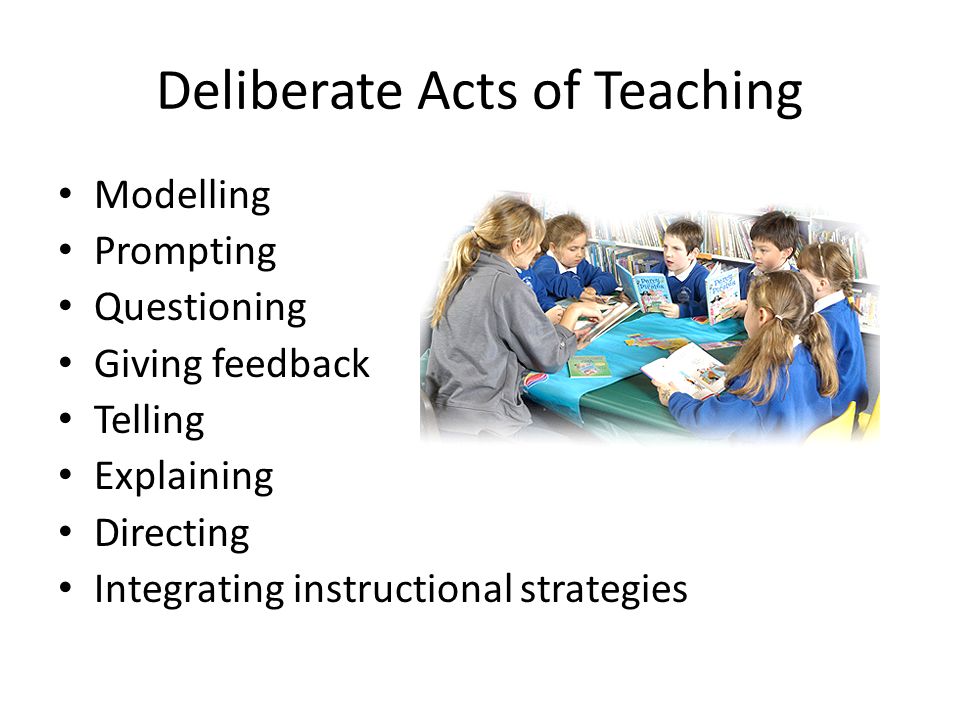
Instructional strategies are the tools of effective practice. They are the deliberate acts of teaching that focus learning in order to meet a particular purpose. Instructional strategies are effective only when they impact positively on students’ learning.
Effective Literacy Practice in Years 5 to 8, p. 78
Teachers need to be able to use a range of deliberate acts of teaching in flexible and integrated ways within literacy-learning activities to meet the diverse literacy learning needs of our students.

Deliberate Acts of Teaching


Apparently ERO feels we weren't able to show that we were teaching our children, and were too reliant on a use of technology to do so.
Therefore somehow we need to get better at showing what it is that we actually do!


I checked to see what were classified as 'Deliberate Acts of Teaching.'
Sometimes you just need to use the right jargon. This is something I have tried to avoid throughout my career as I have seen a number of people use jargon as a weapon to show that they know more than others. My pet peeve is 'pedagogy!' I would much rather say things in a way that everybody can understand- isn't that why we are supposed to write plain English, easy to understand reports?

Pedagogy: 

What is Pedagogy?

Pedagogy is defined simply as the method, and practice, of teaching. It encompasses: 
When people talk about the pedagogy of teaching, they will be referring to the way teachers deliver the content of the curriculum to a class.


My challenge is not using the Deliberate Acts of Teaching (I hope!) so much as it is in recording them.

To help I think I will print out the list of deliberate acts of teaching and store them at the front of my planner.
I also need to add those specific words to some generic, as well as specific plans eg handwriting and phonics will include modelling and feedback
Maybe the words can be highlighted or colour coded and specific questions I am planning to use, or do actually use can be recorded in a regular fashion, whether daily, weekly, per lesson type...

Next steps:
. Print deliberate acts of teaching and put in planner
. Record at least one deliberate act of teaching in planner each week, increasing frequency as it becomes a habit
. Aim to complete the daily class journal daily!
I also found a great lesson plan about simple sentences which outlines DATS through out


  • Use of inquiry to inform planning and teaching.
  • Checking to see if planning and delivery of programme is tailored to the strengths, needs and interests of ākonga.
  • Using appropriate pedagogies to accelerate progress of ākonga who are achieving below national expectations

29 October 2019

TBCS - Deliberate Acts of Teaching - Writing - Margaret

Inquiry - Does allowing students to choose according to their interests what they wish to write about improve motivation to write and overall writing levels?

6 students have been identified as achieving below their expected level in writing.  This has been determined from asttle writing tests, observations of students in class, daily writing samples.  Their overall motivation to write is low and writing that is done uses improper sentence structure, lack of detail and ideas expected at a year 6/7/8 level.

Strategies used:

Splitting class into groups of boys/girls to brainstorm together possible persuasive writing topics in practice for assessment based on interest.

Brainstorming together a list of possible interests to write to our focus on persuasive writing.  Teacher chooses 1 to write together as shared writing.

Shared writing

Read together an article related to chosen topic - use this to help brainstorm.

Brain storm as a  class ideas that we can use to persuade.  Benefits, experiences.  Questioning to draw out ideas.  What are the benefits of havng a pet?  How would this benefit the teacher?  How can pets help us?

Model how to write an introduction with student suggestions
Model how to write our first paragraph using one of our ideas, using persuasive language - write a list of persuasive language that students can select from.
Independent - students to write their second and third paragraph independently.
Model how to write a conclusion.
Independent - students write their own conclusion.

During next session students choose which topic they would like to write about using the model as a guide.


Reading together a variety of persuasive writing from Mainsails then having students select which topic they want to write about

Class is given a selection of persuasive texts from Mainsails.  In pairs they choose which ones they would like to read.  Students read together and note down 3 main ideas from their favourites.

Select one that has had the most interest to break down together

Questioning
Look at the intro, body and conclusion
What persuasive language was used?  What are the main ideas for each paragraph?  Has the author used examples to back up their ideas?  Who are they trying to convince?
Model a plan on the board.

Students choose which persuasive topic either from the book or their own to write.

Journals/Free writing/competitions

Students given free writing journals - not to be marked
Brainstorm as a class ideas we may like to write about in our jounals - students to write all this up in their books to prompt ideas.  Use questioning to draw out ideas - What are your interests, what styles of writing do we like to use?  What do we like to read/do?

20 mins of free writing daily with 5 mins to check over what they have written

Feedback

Students share their daily writing with the class if they choose.  Use our feedback guide that was taught at the start of the year - a compliment, a suggestion, editing.

Students to select 1 piece of writing each week/fortnight to publish.  Use the writing process/ peer editing process taught at the start of the year to improve it.  Conference with me or feedback using google docs before final copy is published.