Showing posts with label Deliberate Acts of Teaching. Show all posts

25 February 2020

TBCS - Craig - Teaching Maths 2020


I have spent time reflecting on last year and what my students were able to achieve in Maths...
While I was happy that all my students made good progress, I still felt that because the topics changed so quickly, that the basic foundational concepts were still not second nature and that there was hesitation and not confidence displayed when given a random problem to solve. While my emphasis was on learning the lessons and not just completing them, it was hard to keep on top of 20 students all doing different things at the same time. There was still a resistance to learning times tables and this also caused a more than acceptable reliance on times tables charts. There were also common concepts that were shown up when helping individuals and in the e-asttle testing. some of these were Rounding - Greater Than, Less Than - Place Values - Words associated with different operations like difference, sum, quotient, product etc...

This Year

I have decided to put more effort into group teaching and to use Maths Buddy more as a supplement.

I made up two Maths groups determined by the levels each student is working at on Maths Buddy.

I have made a list of topics to cover and a spreadsheet to record each student's progress.

I will pretest the group at the start of each topic to find out where each student is in their understanding. I will teach the topic and give time for practice. When a student feels capable and I am confident that they have proved their capability they can carry on with their Maths Buddy lessons. The remaining students will practice further with me until they are confident. My emphasis is knowing the concept and confidence and not in covering a certain number of topics. I am going to focus mainly in Number and go at the speed of the students. I want my students to enjoy Maths, and enjoyment comes from confidence.

I have also renewed my determination that every student will know their times tables as second nature by the end of the year. To do this we have a set of tables that we will focus on every week. They will be chanted and gone over every day and will be tested on Fridays to give weight and importance.

A welcome letter was sent to all families of my students to let them know what is new in the program this year and how they can help and monitor their child (ren)


12 - February
Because of what has come up in Maths Buddy very early on, I have decided to teach Rounding first.
I started this topic as a whole class rather than two groups as everyone seemed to be at the same place with the same struggles.

20 - February
Some students are happy that they understand rounding and are spending time on Maths Buddy. Their knowledge has been put to good use as they have easily passed the Rounding portion of their lessons.

Some students are still struggling to pick up the process being taught to circle - arrow - ask - write - zeros. I am persevering, believing that once they can master it, consecutive concepts and processes will become easier.


  • Structuring learning tasks so that all ākonga experience a degree of success, but also ensuring that they are required to stretch themselves to fully succeed.
  • Adapting lessons to ensure they address ākonga needs and interests as they arise.
  • Holding high, but attainable academic expectations and sharing those expectations with ākonga and their whānau.
  • Monitoring of ākonga learning during the implementation of a programme of learning, so that the programme can be adapted where needed to better achieve desired outcomes for ākonga.

  • Using feedback from classroom observations to improve learning programmes.

18 February 2020

Margaret- Deliberate Acts of Teaching - Writing

Writing in Room 4

Link to Standards

Design for Learning 
Design learning based on curriculum and pedagogical knowledge,
assessment information and an understanding of each learner’s strengths,
interests, needs, identities, languages and cultures.

Elaboration

• Select teaching approaches, resources, and learning and assessment activities based on a thorough knowledge of curriculum content, pedagogy, progressions in learning and the learners. 

Harness the rich capital that learners bring by providing culturally responsive and engaging contexts for learners.


One of our targets is to lift the achievement in Year 8 Writing.  As part of our strategy to do this, we are again running the ALL program with a small number of students in Room 4.  Alongside this, we also aim for daily journal writing where students choose to write about whatever they are interested in without worrying about spelling, punctuations, etc.  The aim is to have students choose at least 2 pieces of writing from their journal each term to edit and publish with support from the teacher.

The context for learning: Learning how to summarise using newspaper articles in preparation for writing our own articles related to our Japan topic.

Wednesday 12 February 2020
Mel/ALL group:  Mel took a group of 4 out including our Year 8 student to discuss the activity of reading the news article/highlighting main words in each paragraph and then summarising orally.
Back as a whole class we then read through the article altogether.  We highlighted the main words in the first two paragraphs together as a class.  The class was then asked to read through the next paragraphs in their groups and record the words. Mel worked with the ALL group for 10 minutes while I worked with others needing support.  When Mel left we moved that needed support together and read through paragraphs one at a time.  Students had to come up with 20 words to summarise the article. We finished by going around the groups sharing what we thought the article was about.

What worked well?  The ALL students showed a good understanding of what was expected with some needing support to stay on task. 2 manages to do this independently 3 still needing support.

Next Steps:  We will do another article next time again scaffolded before letting students complete independently.  More time to discuss unknown words to develop comprehension.  Review who needs to be in the group as 2  seemed very capable but will try them out on a few different activities first.

Wednesday 26 February 2020
After looking at who actually needs to go out with Mel we chose our 4 who need that extra support.  Today we began our Get NZ writing topic which was writing a poem of our naughtiest moment.  The discussion time with Mel beforehand meant that the group came in ready to start immediately after our introduction.  They had their idea.  I did get them to write out the questions to answer which took a lot longer than I had hoped so perhaps for this group have the questions printed up to simply answer.  Some had lots to say verbally but did not get much written down.  Could we record their ideas for some of them and they write out the final copy just to get ideas started.

Links to Standards

  • How am I planning my learning programmes and selecting appropriate teaching strategies to best meet the needs of my ākonga?  I think about what skills are needed for the end product eg a newspaper report advertisiing Japan and structure each lesson around this skill unitl they can do this independently
  • How can I improve my pedagogical content knowledge in areas where my ākonga struggle to master new skills or knowledge?
  • How can my knowledge of human development, especially cognitive and social development, inform my planning and teaching?
  • Do I effectively analyse and use assessment data to inform my teaching and planning?
  • Do my own and the school’s systems generate the formal and informal assessment information that I need to plan for and effectively support my ākonga? 
  • How can I use the schoolwide assessment data effectively to inform my practice?
  • What other formal and informal sources of data could I be using?
  • How do I know that my ākonga are progressing?

Margaret - Maori Language Program 2020- Deliberate Acts of Teaching


2020 Maori Language Program
Links to Standards

Te Tiriti o Waitangi Partnership 
Demonstrate commitment to tangata whenuatanga and
Te Tiriti o Waitangi partnership in Aotearoa New Zealand.

Elaboration
Practise and develop the use of te reo and tikanga Māori.


Questions I might ask myself?/Next Steps

  • Have I actively sought support and guidance to expand and build on my understanding?
  • Have seeked support from our Maori Resource Teacher at Parklands - Tania Corbett and Sean Delany (Kapa Haka Teacher and Parent within the school)
  • Do I practise and develop my use of te reo Māori, and incorporate this into my teaching?
  • I am taking an online course in the evenings to develop my own language skills - Te Kakano
  • What are the educational aspirations of my Māori ākonga?
  • Will be meeting with families to discuss this in Term 1
  • How do I plan to further develop these aspirations?
  • From meeting put into place actions discussed where practical and continue to feedback to families.
  • What efforts have I made to engage with the local iwi and members of the local Maori community, and involve myself in community events?
  • Discussions/conversations with parents, resource teachers, attending local marae events - Kapa Haka, Mau rakau where students are involved.


I have consulted with Sean Delany and Tania Corbett about the most suitable language programs
available.  We have decided on Ka Mau te Wehi which is available in the school and has a structure that is easy to follow and meets the curriculum requirements.

The plan is to try this out for term 1 then review.  I also plan to meet up with families to get there ideas.  Tania Corbett is coming in for 4 weeks to offer support as I begin teaching language.
See Plan below.

Term 1 2020
Integrated Maori Language Program


Room 1and 3 - Year 0-5


Frequency:   Room 1 :1 full day a fortnight
        Room 3 : 15 minutes once a week plus 1 full day a fortnight.


Marae visit as whole school
Tiriti o Waitangi - The Treehouse Treaty
Waiata - Tena Koutou/Greeting song. Revisit known Kapa Haka, Christian Waiata
Nga ra o te wiki/Days of the week
Pepeha - from junior journal.  What is a pepeha. Learning our pepeha.
Stories in Maori along with translations - from resource room
Weekly bible verse - translating using the Maori Bible main words from our verse related to our character trait - courage


Our Amazing Bodies Unit
Waiata around our body from Hei Waiata
Vocabulary related to our bodies 


Developing Resiliency Unit
Use Ka Mau Te Wehi - to ask how you are and respond using different emotions.


Room 4 - Years 6/7/8


Frequency:  Two days a week


 -Marae visit as whole school
- Waiata - Tena Koutou/Greeting song.  Revisit known Kapa Haka, Christian waiata, karakia, whakatauki, preparing waiata for Woodlands visits. 
- Weekly memory verse - translating from the Maori Bible the main words to share with the school - related to our character trait courage.
- Devotions - carving a courage rod


Language


Unit plans from Ka Mau Te Wehi.
If students are progressing well in term 2 begin Toku Reo program

Health/Art


Model of Hauora/Health - Whare
Class activity making our own whare 
- design a class/individual kowhaiwhai for each physical, spiritual, emotional, mental health using patterns in nature.
- research our pepeha and practice speaking
- All About Me interview from class buddy
- What are my beliefs/foundation


Science


Researching Matariki - making links to similarities/differences to Japanese New Year
Cooking - Japanese/Maori foods


Olympics - Japan


Looking at similarities to NZ European/Maori culture and Japan
NZ Olympians


Possible plans for the rest of 2020


Linked to Abel Tasman Tramp in November


History of the local area - Motueka/Abel Tasman - Who can help with this?


Maori Fishing Technology - amazing looking program run through NZ Marine Studies.  Survival game at Marahau Outdoor Education Camp - firelighting, net and hook making etc.  There is a cost involved??


Kapa Haka Term 3 and 4


(AREAS NEEDING SUPPORT IN)

Resources


TKI - Hei Waiata


Toku Reo program for seniors


Ka Mau te Wehi - videos and unit plans

Deliberate Acts of Teaching
12/2/20
First Ka Mau Te Wehi with Room 4
Discussed with the class why we are learning Te Reo Maori - It is part of our culture and part of our agreement in The Tiriti O Waitangi to keep the language alive.
Began learning what macrons were and how to use them.
Watched video with today's phrases - Ata Marie, Haere Mai kei te kai.
Students wrote these  down to help them remember - seeing, hearing, doing, writing
Students each had a go at welcoming their classmates to breakfast before sitting down to a breakfast of pancakes.  I said a karakia which I am hoping the students will learn and be able to say also.

Next steps: Review what we have learned today - saying aloud by memory, working on pronunciation and being able to write fluently -  print self and peer assessment sheets for students at the end of each unit so they can see their progress.

26 February 2020
Our final lesson in unit 1 today.  We first reviewed all the phrases we had learned using our books and our memory.  The task was to create a play using all the phrases.  Our group of year 6 boys needed a little more support with this.  Students were made aware of the peer assessment looking at our memory, pronunciation and writing of the phrases learned. Students were very enthusiastic and most were able to say their plays by memory.  Most of the peer assessment showed memory and writing were areas they would like to improve on.  They all now have their indivual goals to work on from this activity.

Next Step:  Continue to unit 2.  Continue use of waiata to learn phrases.  Have paper copies for individuals when copying phrases as some seem to struggle copying from the board.

16 March 2020
Room 3
Taught new songs with actions related to the body as this is what Craigs topic currently is.  Studewnts glued new phrases into their books focusing on asking where we come from.  Role modelling and asking whole class this question to show pronunciation.  Using the language repetively worked well with this group as some do not read so beginng to say from memory.

Next steps:  Continue practising songs - the students responded well to these.  More role plays to reinforce langauge - videoing also so students can hear themselves.

28 January 2020

TBCS - Craig - Programme Changes 2020


I consulted with my class at the end last year about how the year had gone? What did they like, what did they dislike, and If they would change anything, what would it be?
one overwhelming thing that came forward was the desire to learn more Science. The year fives who were moving up to Room 4 also asked if it could be done when they will be in my room. This happens when MOTEC is on for the Year 7&8s. The class enjoyed the little research I had allowed them to do and wanted to do more. They wanted to range of things we learned to increase and to do more art...


New Year's Resolutions are all the rage at the beginning of the year and no less so as a teacher of a class of young people. We always look at what we do and deliberate over how we can do what we do better. We are of nature never satisfied with what we have done in the past and dream of the effect we will have on our next group of student's progress and desire to continue learning.

One thing I heard over the holidays which I thought was memorable was about new year's resolutions. The person said that most resolutions are wishes. Willpower is enough to get you started, but you need to form habits to continue and to make real change.

In my class this year, I want to change. I want to do better then last year. I want my students to learn more about God's wonderful creation and about how amazingly they have been made. I want them to marvel more at God's power, majesty, and creativeness. I want them to know individually how much God loves them and that they can have a personal relationship with him.

Over the last couple of years, I have made a priority of Bible reading and prayer and encouraged the learning of memory verses that I have chosen to help them. This has gone well and the students have begun to understand God's Word in a deeper way and I want to continue this and go a step further.

This Year


The way to make habits in a classroom is to change the class programme and intentionally give time for subjects that need including and to change the way some things are taught to accomplish the best results.

What I plan to change or include:


  • Teach Math in groups so I know each student has the foundations necessary and include Maths Buddy as a secondary teaching tool.
  • Teach Science as a subject to increase the student's wonder and knowledge of God and the world around them. 
  • Teach Geography as a subject so the students are more aware of the greater world and people groups around them and give them the skills to read and interpret maps.
  • Programme time for students to research topics of their choice and interest giving them skills to research, skills to become discerning about what they read, and the desire to continue learning wherever they are.
  • Allow time for students to record what they have learned and develop the oral skills and confidence to report back to the class in an interesting manner what they have learned. This will, in turn, allow the further use of digital skills in the form of Powerpoint presentations movies, etc.

Have I bitten off more than I can chew?

Time will tell!

To have Student Agency, the students need to be confident in the basics, excited and enthused about their learning and realise that the more they learn, the more they have to learn. If I can be the spark in this, I will have done my job.

I will report back on each change and reflect on how each is going.


Learning focused culture
  • Providing opportunities for ākonga engagement in co-operative learning, and reciprocal teaching. 
Design for Learning
  • Adapting lessons to ensure they address ākonga needs and interests as they arise.
  • Helping ākonga appreciate the value or importance of what they are learning.
  • Providing opportunities for co-operative learning, peer tutoring, reciprocal teaching and inquiry learning to occur.
Teaching
  • Undertaking a detailed evaluation of learning programmes and their impact on all ākonga, that takes into account ākonga feedback.


21 November 2019

TBCS - Craig - Deliberate Acts of Teaching - Maths


Teaching Maths


Maths is one subject I love to teach. I have seen such pleasing progress in all my students. Most of my students are happy to do their Math lessons, and some will even choose to do it at break times or when they have finished other work. I have had a multi-faceted approach to teaching Maths this year.
This year, I have had students working at all the Grade levels from Year 1 - Year 7


My deliberate acts of teaching have included...

  • Testing each student at the beginning of the year to access where they are.
  • Each student is placed at the appropriate level for their skills in the Maths Buddy Programme that the School Uses. (Please see my Blogg on Maths Buddy)
  • Monitor how each student is doing by roaming the room constantly and encouraging and giving help where needed.
  • Monitoring each student through my laptop after hours to identify students who need particular help or groups of students who need help in a particular area and writing them in my weekly planning folder.
  • At the beginning of most lessons, students who needed extra help are brought down to a table so I can help them as individuals or in groups as required. They will go back to their individual desks once they are confident and have passed the lesson they were stuck on.
  • Setting a minimum achievement rate of 80% or more in any given lesson before allowing a student to move on.
  • Year 6 students are to complete a Diagnostic test at the end of each section to ensure all lessons have been learned. If gaps are identified in their learning, they are required to redo those identified lessons again to ensure they are confident before they move on.
  • The emphasis I encourage is not on completing a certain about of work or working at a certain speed, but on learning the concepts and being able to confidently use them, especially in Problem Solving situations. 
  • I encourage students to redo lessons, even if they have passed them at 80% if they are not completely confident in themselves.
  • I place an emphasis on learning times tables which we start every day with.
  • I get the students to do warm-up activities of times tables before they go on with their lessons.
  • If there are particular lessons that the whole class needs to learn, I will gather the whole class around the board and we will go over them together. These have included... 
                      -  Understanding mathematical words like addends and sums, minuends, subtrahends,                              and differences, etc.
                      -  Greater than and less than
                      -  Rounding
                      -  Telling the time.
                      -  And other issues identified in daily classwork or testing such as e-asttle.

  • I try to know where each student is at, and plot their progress on an XL spreadsheet to help me have an overview of the whole class.

Next Steps

Place a bigger emphasis on learning Time Tables and add a Times Tables test at the end of each week to keep the spotlight on our need to know them by rote.

Be more forthright with the expectation that the lessons need to be learned and not just passed. This will include encouraging the students to use a star chart to indicate how confident they are at the end of every lesson, so they can revisit or redo lessons that may have been passed but not confidently grasped.

Make better use of the e-asttle tests that the class sits to identify areas of weakness and get more group work established based on what is identified at the time.


Standard 6
Teach in ways that ensure all learners are making sufficient progress, and monitor the extent and pace of learning, focusing on equity and excellence for all.

Standard 5
Select teaching approaches, resources, and learning and assessment activities based on a thorough knowledge of curriculum content, pedagogy, progressions in learning and the learners.

Standard 4
Manage learning setting to ensure access to learning for all and to maximise learner's physical, social, cultural, and emotional safety.


16 November 2019

TBCS - Deliberate Acts of Teaching - Judy-Anne


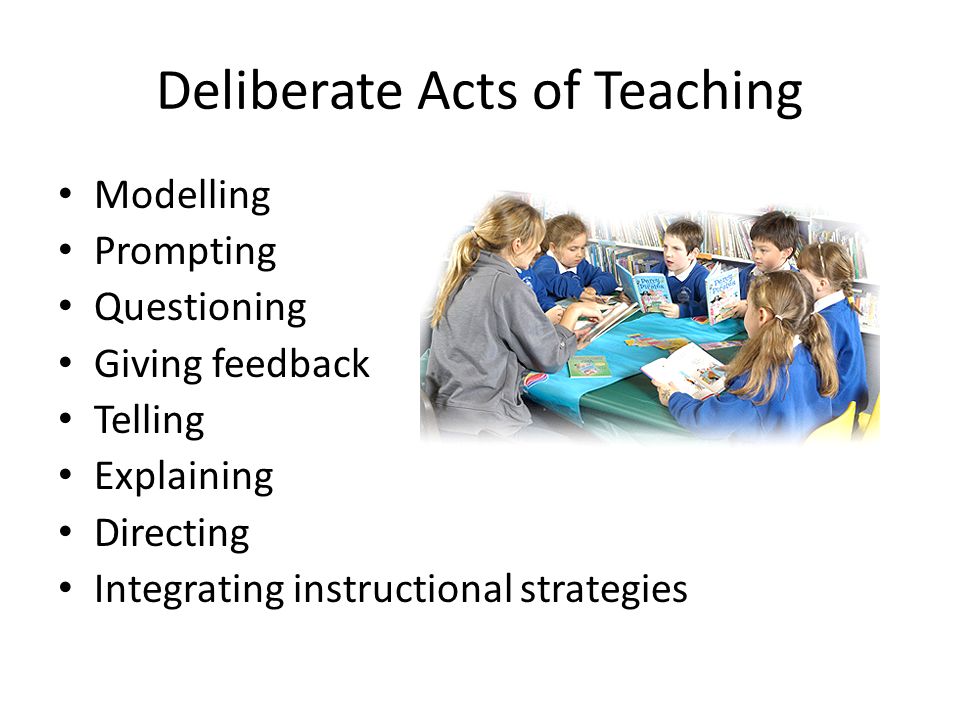
Instructional strategies are the tools of effective practice. They are the deliberate acts of teaching that focus learning in order to meet a particular purpose. Instructional strategies are effective only when they impact positively on students’ learning.
Effective Literacy Practice in Years 5 to 8, p. 78
Teachers need to be able to use a range of deliberate acts of teaching in flexible and integrated ways within literacy-learning activities to meet the diverse literacy learning needs of our students.

Deliberate Acts of Teaching


Apparently ERO feels we weren't able to show that we were teaching our children, and were too reliant on a use of technology to do so.
Therefore somehow we need to get better at showing what it is that we actually do!


I checked to see what were classified as 'Deliberate Acts of Teaching.'
Sometimes you just need to use the right jargon. This is something I have tried to avoid throughout my career as I have seen a number of people use jargon as a weapon to show that they know more than others. My pet peeve is 'pedagogy!' I would much rather say things in a way that everybody can understand- isn't that why we are supposed to write plain English, easy to understand reports?

Pedagogy: 

What is Pedagogy?

Pedagogy is defined simply as the method, and practice, of teaching. It encompasses: 
When people talk about the pedagogy of teaching, they will be referring to the way teachers deliver the content of the curriculum to a class.


My challenge is not using the Deliberate Acts of Teaching (I hope!) so much as it is in recording them.

To help I think I will print out the list of deliberate acts of teaching and store them at the front of my planner.
I also need to add those specific words to some generic, as well as specific plans eg handwriting and phonics will include modelling and feedback
Maybe the words can be highlighted or colour coded and specific questions I am planning to use, or do actually use can be recorded in a regular fashion, whether daily, weekly, per lesson type...

Next steps:
. Print deliberate acts of teaching and put in planner
. Record at least one deliberate act of teaching in planner each week, increasing frequency as it becomes a habit
. Aim to complete the daily class journal daily!
I also found a great lesson plan about simple sentences which outlines DATS through out


  • Use of inquiry to inform planning and teaching.
  • Checking to see if planning and delivery of programme is tailored to the strengths, needs and interests of ākonga.
  • Using appropriate pedagogies to accelerate progress of ākonga who are achieving below national expectations

29 October 2019

TBCS - Deliberate Acts of Teaching - Writing - Margaret

Inquiry - Does allowing students to choose according to their interests what they wish to write about improve motivation to write and overall writing levels?

6 students have been identified as achieving below their expected level in writing.  This has been determined from asttle writing tests, observations of students in class, daily writing samples.  Their overall motivation to write is low and writing that is done uses improper sentence structure, lack of detail and ideas expected at a year 6/7/8 level.

Strategies used:

Splitting class into groups of boys/girls to brainstorm together possible persuasive writing topics in practice for assessment based on interest.

Brainstorming together a list of possible interests to write to our focus on persuasive writing.  Teacher chooses 1 to write together as shared writing.

Shared writing

Read together an article related to chosen topic - use this to help brainstorm.

Brain storm as a  class ideas that we can use to persuade.  Benefits, experiences.  Questioning to draw out ideas.  What are the benefits of havng a pet?  How would this benefit the teacher?  How can pets help us?

Model how to write an introduction with student suggestions
Model how to write our first paragraph using one of our ideas, using persuasive language - write a list of persuasive language that students can select from.
Independent - students to write their second and third paragraph independently.
Model how to write a conclusion.
Independent - students write their own conclusion.

During next session students choose which topic they would like to write about using the model as a guide.


Reading together a variety of persuasive writing from Mainsails then having students select which topic they want to write about

Class is given a selection of persuasive texts from Mainsails.  In pairs they choose which ones they would like to read.  Students read together and note down 3 main ideas from their favourites.

Select one that has had the most interest to break down together

Questioning
Look at the intro, body and conclusion
What persuasive language was used?  What are the main ideas for each paragraph?  Has the author used examples to back up their ideas?  Who are they trying to convince?
Model a plan on the board.

Students choose which persuasive topic either from the book or their own to write.

Journals/Free writing/competitions

Students given free writing journals - not to be marked
Brainstorm as a class ideas we may like to write about in our jounals - students to write all this up in their books to prompt ideas.  Use questioning to draw out ideas - What are your interests, what styles of writing do we like to use?  What do we like to read/do?

20 mins of free writing daily with 5 mins to check over what they have written

Feedback

Students share their daily writing with the class if they choose.  Use our feedback guide that was taught at the start of the year - a compliment, a suggestion, editing.

Students to select 1 piece of writing each week/fortnight to publish.  Use the writing process/ peer editing process taught at the start of the year to improve it.  Conference with me or feedback using google docs before final copy is published.

TBCS - Craig - Inquiry - Reading - Phonics


Background

I teach a Year 4-6 class which has a wide range of abilities. I was excited to have new students join my class. One, in particular, a year 4 student I will call "N" came to my class with the label of Dyslexia. It became apparent very early one that she was unable to read. She had not been taught Reading or Writing at all and was functioning at a Year 1 level. What a challenge!
I come from a school where every student was taught using a comprehensive phonics programme and I saw the results with my own children and with the other students I taught in the school. Would this work for N?
Lexia, our normal programme for foundational reading training is not working for her. She was assessed at a year one level and with no prior learning in sounds and no word attack skills, she is struggling and I need to think of another way to help her learn...

Question

How can I best help N  catch up 4 years of learning in English?

Inquiry

Can teaching a full phonics programme to N help her to read and therefore write and reach a Level 2 level in her work?

......................................................

From the book, "Effective Literacy Practice in Years 1-4" Ministry of Education, pg 32

"In order to become readers and writers, children need to develop a knowledge of the name and sounds of the letters of the alphabet and of letter-sound relationships."

"Children do not have to be able to name every letter of the alphabet before they begin formal instruction in reading and writing. They do, however, need to develop phonemic awareness and to understand that there is a relationship between spoken sounds and the letters that represent them."

"Phonemic awareness is fundamental to early success in reading and writing. It enables children to develop the understanding of letter-sound relationships that is essential to decoding and encoding. Children have to be able to distinguish sounds before they can match them with the letters that represent them."

"An understanding of phonics also underpins children's literacy learning. Children need to learn through deliberate, focused instruction, which letters represent which sounds. they learn a great deal about letter-sound relationships through writing. Beginning writers constantly engage with the problem of which letters represent the sounds in the words they want to use. In doing so, they lay a sound basis of knowledge about relationships between letters and sounds. Effective teaching helps writing the understandings they gain during reading and oral language activities."

......................................................

From the "New Zealand Curriculum" Level One English

Listening. Reading, and Viewing
Processes and strategies
Students will...

Acquire and begin to use sources of information, processes, and strategies to identify, form, and express ideas.

Indicators
  • has an awareness of the connections between oral, written, and visual language.
  • uses sources of information (meaning, structure, visual and grapho-phonic information) and prior knowledge to make sense of a range of texts.
  • associates sounds with letter clusters as well as with individual letters.

......................................................

S.E.N.C.O's help was sort.

I tested N in

Maths (J.A.M), Working at Level 1
Reading (Running Record) Level 1 at 50% accuracy
Writing (Sample) 10 minute unassisted  10 words 40% correct.
Spelling (Essential Selling Lists) 5/10 for list 1. 6/20 for list 2

N was separately tested for letter names, both upper and lower case and short sounds of letters.
Letter names 19/26 Short sounds 22/26 Blends7/36

An application was lodged with the R.T.L.B with an I.C.S (In Class Support) Assesment asking for an hour a day teacher aid time to help N and give me extra time to help her.

I talked through the issue with my principal. I shared with him that I wanted to use the phonics programme that had been developed in my last school. He agreed to contact my last school to seek permission to use the programme. Permission was given.

In a meeting with the principal and S.E.N.C.O we talked through the best method of delivery and could we find or modify any teacher aid hours to free me to run this programme with her. It was agreed that room 4 could decrease their time with the teacher aid, giving me 20 mins 4 times a week to run this programme with her.

The programme comprises of 115 individual sheets that cover all letter sounds short and long, blends,

The programme will be delivered in a one on one situation using the sheets along with the teaching strategies of modeling, prompting, questioning, giving feedback, and explaining. (Effective Literacy Practice, Deliberate acts of Teaching pg 76-87)

15th August We started. Spent time on alphabet letter names and short sounds of letters. There were several letters she stumbled on. Three, in particular, were b, d, and p. The sheet worked on the short 'a' sound.

16th August We revised the alphabet letter sounds, redid sheet 1 to check that what we had learned the day before had been 'caught' and introduced sheet 2 which was also on the short 'a' sound.

A similar pattern is followed each session. We always go through all the letter sounds to start. We revise the sheet from last time. I introduce the new sheet. I only shart a new sheet if the previous sheet is completed without error.

The sheets explored the short sounds a, e, i, o, u, and them reviewed them for several sheets.

17 September Sheet 9. We have completed the short sounds of the vowels and are beginning the blends.
It takes a little for N to catch on, but with some modeling, prompting, and explaining, she catches on and we complete the first of the blends.
She quickly takes the concept on board and makes blends of other letters that are not being targetted by the sheets, showing good thought process and transference of knowledge.

16th October Sheet 16. This sheet is working on blends at the ends of words - ft, ld, lf, lk, lp, lt. the blends are not so hard, but the 'e' in the middle of some of the words trip her up. Words like self, weld, and felt with a short e sound that doesn't seem to fit was a stumbling block. I ended up teaching her that 'el' says long l. This departed a little from the lesson with ending blends but made more sense. It took 4 consecutive goes to complete this sheet.

29 October Sheet 18. Today we looked at the ending 'ng'. N made good progress and we will go through the sheet again tomorrow.

Exciting News! N got back to class after completing her phonics lesson and managed to complete 15 units in Lexia! She is transferring what she is learning and it is making a big difference in her classwork. She is proud of herself and I am proud of her too!

31 October Sheet 19. We looked at end blends 'nk' and 'nt'. Steve observed my lesson and in discussion with N after the observation, he found out that I also get N to copy out the words on the sheet. This helps her not only learn the sounds, but also to learn how to correctly form the letters. This is done as an extra to Penmanship which is taught separately. Steve found out that she didn't say the sounds in her head as she wrote them.

From now on I am going to encourage N and the others doing the Phonics programme to say the sounds of the letters and blends as they write them, thus forming stronger connections.
Thanks Steve.


End of Year
Great progress has been made, but we have only just really started... I look forward to continuing next year.

2020


25 February.
The year has begun for real. N is continuing to make pleasing progress and us up to sheet 29.
R is progressing well and is up to sheep 21.
M left the school, so, unfortunately, did not get to finish the program which was a great shame.

Two more students who did not learn phonics in the junior class were identified as students who would benefit from going through the program, so I now have 4 individual lessons to give. Teacher aid time has been given to cover the time required. W has made a quick start and is already up to sheet 11 and K is up to 9.

One new aspect I want to do for my phonics students is to place them in a reading group together where they can have the freedom to sound words and encourage each other to put into practice what they are learning. It will also increase interest and help them see their own progress.


Design for Learning

  • Structuring learning tasks so that all ākonga experience a degree of success, but also ensuring that they are required to stretch themselves to fully succeed.


Teaching
  • Using feedback from classroom observations to improve learning programmes.
  • Seeking advice and feedback from colleagues on planning units, useful resources, and strategies to enhance ākonga interest and engagement.
  • Monitoring of ākonga learning during the implementation of a programme of learning, so that the programme can be adapted where needed to better achieve desired outcomes for ākonga.



27 October 2019

TBCS - Deliberate Acts of Teaching - Reading - Margaret

Inquiry - Will deliberate instruction in areas where my low reading group is struggling, improve their comprehension?

4 students have been identified as achieving below their expected level in reading.  This is determined from asttle reading tests, observations of students working through the reading program  and during silent reading by their choice of books and their levels of motivation to read.

They have been put on our Power Up Program for Year 7 and 8s.  I monitor this to check on areas where they may be struggling.  Once an area has been identified, I get the students in a group to specifically teach around that identified area.  They are then given time to work independently with myself monitoring their progress.  If no improvement is made the next day I will gather them again to give further instructions in this area until they understand it fully.

Mel also works with 1 student doing a phonics program to enhance what is being learnt in Power Up and in groups.

Effective Literacy Practice Years 5-8

From Effective Literacy Practice Years 5-8 "To be successfully literate, students need to master three key areas of reading and writing: learning the code, making meaning, and thinking critically.
Making meaning: This involves developing and using knowledge, strategies, and awareness in order to get and convey meaning when reading or writing. It also involves understanding the forms and purposes of different texts and becoming aware that texts are intended for an audience.
Thinking critically: Becoming literate involves reading and writing beyond a literal, factual level. It involves analysing meanings, responding critically to text when reading, and being critically aware when composing texts. It also involves responding to texts at a personal level, reflecting on them, and finding reward in being a reader and a writer."
Teaching Comprehension - Making Connections
Helping students to make connections between what they know and what they are reading improves their comprehension. Teachers can model making such connections, and prompt students to make links with their own knowledge and experience, when they are introducing and discussing texts for reading and in writing and oral-language activities. When activating students’ prior knowledge for a particular purpose, teachers can help the students to hypothesise, infer, and build their own interpretations as they read.


Area:  Deliberate instruction in Comparing and Contrasting - Student N

Define the terms compare and contrast.  Use two similar objects.
Shared:  List together things that are similar/different.  Model how to put these into the graphic organiser.

Independent:  Get students to compare and contrast the picture given using the graphic organiser. Support where needed.

Encourage words such as but, whereas, similarly when comparing.  Write these on cards as prompts for students.

Share how this will improve our reading
Helps us focus on whats important when reading
Remember key ideas and details
Think about what you read in a different way
Discuss and write about what you have read

Shared:  Work through sample sentences together choosing correct comparing/contrasting word.  Note who is doing this independently.  These students can go back onto Power Up to give lesson a go.  Continue working with those needing support.

Reflection:
31/10/19
Worked with N on comparing and contrast which showed up as an area she was struggling with.  Once she understood the difference between these words she could easily complete the activity.  I had her use the venn diagram to record compare and contrast between a phone and a laptop.  She had lots of ideas but needed help recording these down so we sounded out each letter or I helped her with some so it didnt become frustrating. N seems to have a good grasp of blends when she stops to think but struggles with middle and end sounds (computer, glass, batteries, keyboard)  We may need to go back to basics (Lexia) though as she is a Year 7 I will keep monitoring to see if she can catchup to where she should be.  With Mels phonics program targeting this area it may be enough.
Went through comparing sentence together which she did easily though some help reading the sentences needed.
N began the lessons in Power Up after this and seemed to have a better grasp of the concept.  She has not completed it yet so will check to see how she went independently.

1/11/19
N worked through the comparing and contrast section in Power Up.. I helped her with the first few questions then after seeing she had a pretty good idea I left her to complete independently.  When she had completed these she came to tell me she had passed them all and was ready to move onto the next section.  She told me she got it now.

7/11/19
Worked with n and M today on their individual lesson.  They both were very unfocused today so had them sitting beside me while I helped them work through questions. M was working on finding the pace to put a pause in a sentence using commas which she had trouble with so I had her say the sentences out loud so she could hear that natural pause.

25/11/19
Worked with N and M
Identified Area:  Comprehension - Sensory Language
From Effective Literacy Practice Years 5-8
When readers visualise, they connect the ideas in the text with their prior knowledge and experience to create images in their minds. This often means thinking about their senses and using their imagination to see, hear, feel, taste, or smell parts of the text in their minds.
Creating an image can make a text come alive for the reader. The ability to visualise what is being explained or what is happening draws readers into the text. Studies have indicated that creating an image in the memory helps the reader to retain what is read and use it later on.
Readers experiencing difficulties often need help with creating mental images and may not realise how this can help their comprehension. Teachers can support students in visualising by asking questions such as “What image do you see in your head?”, by explicitly drawing attention to descriptive language or a sequence of ideas, and by sharing their own images. Visualising can be supported by creating graphic representations or mind maps of a text.
Lesson
The two girls came to sit with me as I first discussed what our focus was today - using sensory language to help us comprehend and remember what we read.  I started by reading out the restaurant description while they drew what images they had in their heads.  I prompted them to begin with - what else?  what would it look like?  We then looked through the words that helped to create those images and had the girls highlight these.  What do they notice about the words?  M came up with that they are all related to our senses so we discussed what our sense were - seeing, feeling, hearing etc  What mood did these words create?
I then read the next description.  The girls again drew the pictures listening to the sensory words.  They seemed to have a better understanding this time round.  They then highlighted the sensory words and discussed what they had drawn.  They were both able to give detailed descriptions of what they had drawn related to the story.  I then asked them if we took all those words out what kind of impact would that make.  They were not sure so we did one as an example noting that it didn't put any pictures in our head therefore had less impact - was less interesting.  We discussed why using these words was important in our reading and took it back to the learning intention of sensory words help us to remember what we read, create the mood and help us understand what we a reading.

Reflection

Both girls were very engaged in this task and had much to contribute. N needed a little more prompting but by the end of the lesson she had a lot more to say.  The girls went onto their Power Up after this where I monitored what they were doing while I worked with other students.

26/11/19
M has passed all her lessons on Power Up and is no longer 'struggling"  She is currently working independently.  I will continue to monitor to see where the next area she may need help in.  N is still struggling so will work with her next lesson.

27/11/19
Worked with N on her lessons.  I had her read out the text aloud and she had to find the missing word.  I used card to break up the word as she is struggling with some of the blends.  She can manage to sound out difficult words this way.  She has a good understanding as she reads though needs to be encourage to slow down and see if the word makes sense in the sentence.
Reflection
Will continue to work with N next lesson.

28/11/19
Worked with N.
Grammar- Simple Sentences
Nouns / using a/an- Me and Nikita worked through the lesson on nouns placing them into person, place, thing or idea.  She got slightly confused between place and thing.  We then looked at using a/an before a noun using the rule of an before a vowel sound. N then placed words into a sentence making sure they made sense as she wrote.
Reflection
N needed support with this but managed to complete the sentences independently.  She is currently working thorugh the lessons on Power Up independently.  Next session with N will be on verbs.

Also worked with M today as he was showing up he was gwetting below 80% in his reading comprehension.  We worked throught he questions together getting M to focus on reading the passage looking for the key words to help him answer the question.  A bit of inferencing involved and discussing meaning of unfamiliar words - gratifying.  Gave strategies for what to do when coming across these words.  Reading on for sense.  M scored 80% which is an improvement.  Will check how he does by himself tomorrow.


Links to Standard for Teaching

Design for Learning

Deisgn learning based on curriculum and pedagogocal knowledge, assessment information and an understanding of each learners strenghts, interests, needs, identitiies, language and culture.

Gather, analyse and use appropriate assessment information, identifying progress and needs of learners to design clear next steps in learning and to identify addtional supports or adaptations that may be required.

Strategies Used

Employing scaffolding strategies to support ākonga master new skills and knowledge and thus achieve independence.

Effectively using a range of digital technologies to engage ākonga and enhance their learning.  Creating an environment where open, productive dialogue is valued. 

Using assessment data to build my understanding of the relationship between my practice and outcomes of learning, achievement and wellbeing of ākonga.

Evaluating how the achievement data for my class(es) fits with the department/syndicate/school-wide data.

Providing ākonga with opportunities and time to apply feedback and feedforward information to improve their mastery of knowledge and skills.