Showing posts with label 6 - Teaching. Show all posts

21 November 2019

TBCS - Craig - Deliberate Acts of Teaching - Maths


Teaching Maths


Maths is one subject I love to teach. I have seen such pleasing progress in all my students. Most of my students are happy to do their Math lessons, and some will even choose to do it at break times or when they have finished other work. I have had a multi-faceted approach to teaching Maths this year.
This year, I have had students working at all the Grade levels from Year 1 - Year 7


My deliberate acts of teaching have included...

  • Testing each student at the beginning of the year to access where they are.
  • Each student is placed at the appropriate level for their skills in the Maths Buddy Programme that the School Uses. (Please see my Blogg on Maths Buddy)
  • Monitor how each student is doing by roaming the room constantly and encouraging and giving help where needed.
  • Monitoring each student through my laptop after hours to identify students who need particular help or groups of students who need help in a particular area and writing them in my weekly planning folder.
  • At the beginning of most lessons, students who needed extra help are brought down to a table so I can help them as individuals or in groups as required. They will go back to their individual desks once they are confident and have passed the lesson they were stuck on.
  • Setting a minimum achievement rate of 80% or more in any given lesson before allowing a student to move on.
  • Year 6 students are to complete a Diagnostic test at the end of each section to ensure all lessons have been learned. If gaps are identified in their learning, they are required to redo those identified lessons again to ensure they are confident before they move on.
  • The emphasis I encourage is not on completing a certain about of work or working at a certain speed, but on learning the concepts and being able to confidently use them, especially in Problem Solving situations. 
  • I encourage students to redo lessons, even if they have passed them at 80% if they are not completely confident in themselves.
  • I place an emphasis on learning times tables which we start every day with.
  • I get the students to do warm-up activities of times tables before they go on with their lessons.
  • If there are particular lessons that the whole class needs to learn, I will gather the whole class around the board and we will go over them together. These have included... 
                      -  Understanding mathematical words like addends and sums, minuends, subtrahends,                              and differences, etc.
                      -  Greater than and less than
                      -  Rounding
                      -  Telling the time.
                      -  And other issues identified in daily classwork or testing such as e-asttle.

  • I try to know where each student is at, and plot their progress on an XL spreadsheet to help me have an overview of the whole class.

Next Steps

Place a bigger emphasis on learning Time Tables and add a Times Tables test at the end of each week to keep the spotlight on our need to know them by rote.

Be more forthright with the expectation that the lessons need to be learned and not just passed. This will include encouraging the students to use a star chart to indicate how confident they are at the end of every lesson, so they can revisit or redo lessons that may have been passed but not confidently grasped.

Make better use of the e-asttle tests that the class sits to identify areas of weakness and get more group work established based on what is identified at the time.


Standard 6
Teach in ways that ensure all learners are making sufficient progress, and monitor the extent and pace of learning, focusing on equity and excellence for all.

Standard 5
Select teaching approaches, resources, and learning and assessment activities based on a thorough knowledge of curriculum content, pedagogy, progressions in learning and the learners.

Standard 4
Manage learning setting to ensure access to learning for all and to maximise learner's physical, social, cultural, and emotional safety.


16 November 2019

TBCS - Deliberate Acts of Teaching - Judy-Anne


Instructional strategies are the tools of effective practice. They are the deliberate acts of teaching that focus learning in order to meet a particular purpose. Instructional strategies are effective only when they impact positively on students’ learning.
Effective Literacy Practice in Years 5 to 8, p. 78
Teachers need to be able to use a range of deliberate acts of teaching in flexible and integrated ways within literacy-learning activities to meet the diverse literacy learning needs of our students.

Deliberate Acts of Teaching


Apparently ERO feels we weren't able to show that we were teaching our children, and were too reliant on a use of technology to do so.
Therefore somehow we need to get better at showing what it is that we actually do!


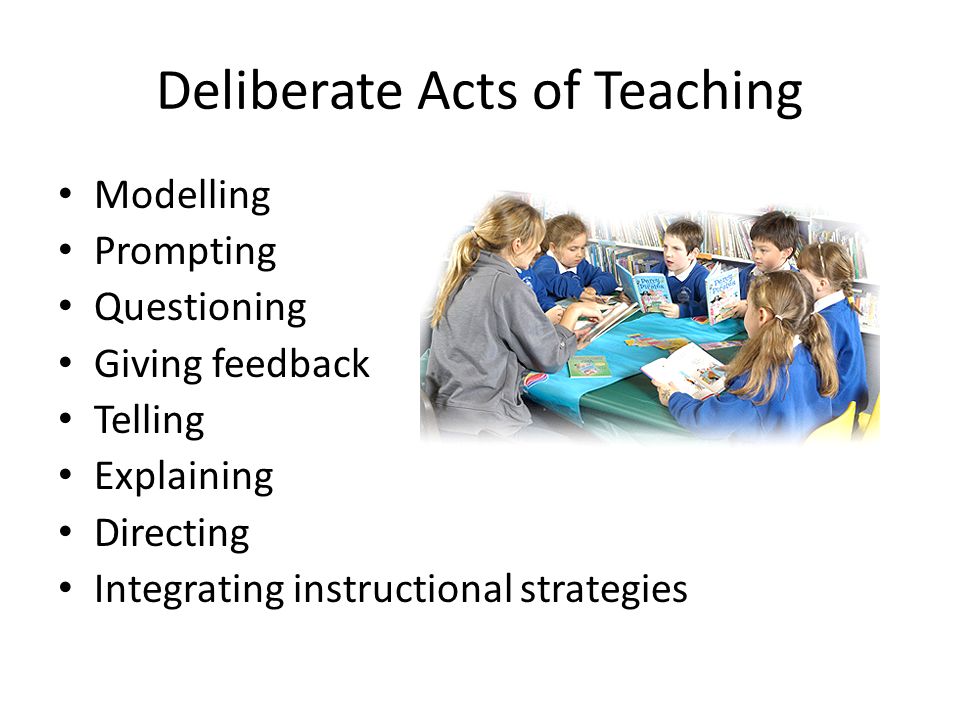
I checked to see what were classified as 'Deliberate Acts of Teaching.'
Sometimes you just need to use the right jargon. This is something I have tried to avoid throughout my career as I have seen a number of people use jargon as a weapon to show that they know more than others. My pet peeve is 'pedagogy!' I would much rather say things in a way that everybody can understand- isn't that why we are supposed to write plain English, easy to understand reports?

Pedagogy: 

What is Pedagogy?

Pedagogy is defined simply as the method, and practice, of teaching. It encompasses: 
When people talk about the pedagogy of teaching, they will be referring to the way teachers deliver the content of the curriculum to a class.


My challenge is not using the Deliberate Acts of Teaching (I hope!) so much as it is in recording them.

To help I think I will print out the list of deliberate acts of teaching and store them at the front of my planner.
I also need to add those specific words to some generic, as well as specific plans eg handwriting and phonics will include modelling and feedback
Maybe the words can be highlighted or colour coded and specific questions I am planning to use, or do actually use can be recorded in a regular fashion, whether daily, weekly, per lesson type...

Next steps:
. Print deliberate acts of teaching and put in planner
. Record at least one deliberate act of teaching in planner each week, increasing frequency as it becomes a habit
. Aim to complete the daily class journal daily!
I also found a great lesson plan about simple sentences which outlines DATS through out


  • Use of inquiry to inform planning and teaching.
  • Checking to see if planning and delivery of programme is tailored to the strengths, needs and interests of ākonga.
  • Using appropriate pedagogies to accelerate progress of ākonga who are achieving below national expectations

9 November 2019

TBCS - Decodable Texts - Judy-Anne


Inquiry:

So I had been seeing posts on Facebook pages about decodable texts and how amazing they are but didn't know what they were or why they were so great, and I also wasn't sure how to get new resources with an empty money pot!

I did a little research on them today and discovered they are phonics based. There are heaps of free ones available, some online and some that you can print but looking at them I realise we have some of them sitting in the back room as well. What a bonus!

I am wondering whether increasing use of phonics and decodable texts will help my youngest boys with their reading at a more accelerated pace.

Action Plan:

. Set up the phonics song on the sample student on seesaw so they can access it for themselves more readily
. use decodable texts with Samuel, Beauden, William and Elijah
.continue to work on blends with the whole class


Chalking on Blogger

Decodable books


  • Undertaking PLD and further professional reading.
  • Engaging with school-wide inquiry approaches as expected.


  • Use of inquiry to inform planning and teaching.
  • Checking to see if planning and delivery of programme is tailored to the strengths, needs and interests of ākonga.
  • Using appropriate pedagogies to accelerate progress of ākonga who are achieving below national expectations.

29 October 2019

TBCS - Craig - Inquiry - Reading - Phonics


Background

I teach a Year 4-6 class which has a wide range of abilities. I was excited to have new students join my class. One, in particular, a year 4 student I will call "N" came to my class with the label of Dyslexia. It became apparent very early one that she was unable to read. She had not been taught Reading or Writing at all and was functioning at a Year 1 level. What a challenge!
I come from a school where every student was taught using a comprehensive phonics programme and I saw the results with my own children and with the other students I taught in the school. Would this work for N?
Lexia, our normal programme for foundational reading training is not working for her. She was assessed at a year one level and with no prior learning in sounds and no word attack skills, she is struggling and I need to think of another way to help her learn...

Question

How can I best help N  catch up 4 years of learning in English?

Inquiry

Can teaching a full phonics programme to N help her to read and therefore write and reach a Level 2 level in her work?

......................................................

From the book, "Effective Literacy Practice in Years 1-4" Ministry of Education, pg 32

"In order to become readers and writers, children need to develop a knowledge of the name and sounds of the letters of the alphabet and of letter-sound relationships."

"Children do not have to be able to name every letter of the alphabet before they begin formal instruction in reading and writing. They do, however, need to develop phonemic awareness and to understand that there is a relationship between spoken sounds and the letters that represent them."

"Phonemic awareness is fundamental to early success in reading and writing. It enables children to develop the understanding of letter-sound relationships that is essential to decoding and encoding. Children have to be able to distinguish sounds before they can match them with the letters that represent them."

"An understanding of phonics also underpins children's literacy learning. Children need to learn through deliberate, focused instruction, which letters represent which sounds. they learn a great deal about letter-sound relationships through writing. Beginning writers constantly engage with the problem of which letters represent the sounds in the words they want to use. In doing so, they lay a sound basis of knowledge about relationships between letters and sounds. Effective teaching helps writing the understandings they gain during reading and oral language activities."

......................................................

From the "New Zealand Curriculum" Level One English

Listening. Reading, and Viewing
Processes and strategies
Students will...

Acquire and begin to use sources of information, processes, and strategies to identify, form, and express ideas.

Indicators
  • has an awareness of the connections between oral, written, and visual language.
  • uses sources of information (meaning, structure, visual and grapho-phonic information) and prior knowledge to make sense of a range of texts.
  • associates sounds with letter clusters as well as with individual letters.

......................................................

S.E.N.C.O's help was sort.

I tested N in

Maths (J.A.M), Working at Level 1
Reading (Running Record) Level 1 at 50% accuracy
Writing (Sample) 10 minute unassisted  10 words 40% correct.
Spelling (Essential Selling Lists) 5/10 for list 1. 6/20 for list 2

N was separately tested for letter names, both upper and lower case and short sounds of letters.
Letter names 19/26 Short sounds 22/26 Blends7/36

An application was lodged with the R.T.L.B with an I.C.S (In Class Support) Assesment asking for an hour a day teacher aid time to help N and give me extra time to help her.

I talked through the issue with my principal. I shared with him that I wanted to use the phonics programme that had been developed in my last school. He agreed to contact my last school to seek permission to use the programme. Permission was given.

In a meeting with the principal and S.E.N.C.O we talked through the best method of delivery and could we find or modify any teacher aid hours to free me to run this programme with her. It was agreed that room 4 could decrease their time with the teacher aid, giving me 20 mins 4 times a week to run this programme with her.

The programme comprises of 115 individual sheets that cover all letter sounds short and long, blends,

The programme will be delivered in a one on one situation using the sheets along with the teaching strategies of modeling, prompting, questioning, giving feedback, and explaining. (Effective Literacy Practice, Deliberate acts of Teaching pg 76-87)

15th August We started. Spent time on alphabet letter names and short sounds of letters. There were several letters she stumbled on. Three, in particular, were b, d, and p. The sheet worked on the short 'a' sound.

16th August We revised the alphabet letter sounds, redid sheet 1 to check that what we had learned the day before had been 'caught' and introduced sheet 2 which was also on the short 'a' sound.

A similar pattern is followed each session. We always go through all the letter sounds to start. We revise the sheet from last time. I introduce the new sheet. I only shart a new sheet if the previous sheet is completed without error.

The sheets explored the short sounds a, e, i, o, u, and them reviewed them for several sheets.

17 September Sheet 9. We have completed the short sounds of the vowels and are beginning the blends.
It takes a little for N to catch on, but with some modeling, prompting, and explaining, she catches on and we complete the first of the blends.
She quickly takes the concept on board and makes blends of other letters that are not being targetted by the sheets, showing good thought process and transference of knowledge.

16th October Sheet 16. This sheet is working on blends at the ends of words - ft, ld, lf, lk, lp, lt. the blends are not so hard, but the 'e' in the middle of some of the words trip her up. Words like self, weld, and felt with a short e sound that doesn't seem to fit was a stumbling block. I ended up teaching her that 'el' says long l. This departed a little from the lesson with ending blends but made more sense. It took 4 consecutive goes to complete this sheet.

29 October Sheet 18. Today we looked at the ending 'ng'. N made good progress and we will go through the sheet again tomorrow.

Exciting News! N got back to class after completing her phonics lesson and managed to complete 15 units in Lexia! She is transferring what she is learning and it is making a big difference in her classwork. She is proud of herself and I am proud of her too!

31 October Sheet 19. We looked at end blends 'nk' and 'nt'. Steve observed my lesson and in discussion with N after the observation, he found out that I also get N to copy out the words on the sheet. This helps her not only learn the sounds, but also to learn how to correctly form the letters. This is done as an extra to Penmanship which is taught separately. Steve found out that she didn't say the sounds in her head as she wrote them.

From now on I am going to encourage N and the others doing the Phonics programme to say the sounds of the letters and blends as they write them, thus forming stronger connections.
Thanks Steve.


End of Year
Great progress has been made, but we have only just really started... I look forward to continuing next year.

2020


25 February.
The year has begun for real. N is continuing to make pleasing progress and us up to sheet 29.
R is progressing well and is up to sheep 21.
M left the school, so, unfortunately, did not get to finish the program which was a great shame.

Two more students who did not learn phonics in the junior class were identified as students who would benefit from going through the program, so I now have 4 individual lessons to give. Teacher aid time has been given to cover the time required. W has made a quick start and is already up to sheet 11 and K is up to 9.

One new aspect I want to do for my phonics students is to place them in a reading group together where they can have the freedom to sound words and encourage each other to put into practice what they are learning. It will also increase interest and help them see their own progress.


Design for Learning

  • Structuring learning tasks so that all ākonga experience a degree of success, but also ensuring that they are required to stretch themselves to fully succeed.


Teaching
  • Using feedback from classroom observations to improve learning programmes.
  • Seeking advice and feedback from colleagues on planning units, useful resources, and strategies to enhance ākonga interest and engagement.
  • Monitoring of ākonga learning during the implementation of a programme of learning, so that the programme can be adapted where needed to better achieve desired outcomes for ākonga.




12 June 2019

TBCS - Number Agents Reading Discoveries - Judy-Anne

http://numberagents.blogspot.com/2018/12/reading-my-discoveries-this-year.html


Reflections:
Wow. One to one reading with each child each week.

Next steps:
So much to do with this
Print Literacy Development poster
Look into de codeable texts
Re -read the article
Re think reading planning
Read a chapter book to the class, rather than picture books. Maybe Enid Blyton as some are reading her at home already.
Try one to one method rather than reading groups for Laila and Violet to begin with.

  • Undertaking PLD and further professional reading.

  • Understanding and using a range of innovative, co-operative and inquiry learning approaches
  • Providing opportunities for ākonga engagement in co-operative learning, and reciprocal teaching. 


  • Planning with ākonga input.
  • Structuring learning tasks so that all ākonga experience a degree of success, but also ensuring that they are required to stretch themselves to fully succeed.


  • Monitoring of ākonga learning during the implementation of a programme of learning, so that the programme can be adapted where needed to better achieve desired outcomes for ākonga.
  • Use of inquiry to inform planning and teaching.
  • Checking to see if planning and delivery of programme is tailored to the strengths, needs and interests of ākonga.
  • Using appropriate pedagogies to accelerate progress of ākonga who are achieving below national expectations.

28 May 2019

TBCS - New student - Judy-Anne


There is a new entrant in Room 1 and at the beginning he settled into class extremely well and was great with listening and following instructions.
I feel now as though the honeymoon period is over and don’t feel I am doing very well with him.
I have been thinking about what to do about him and came up with some ideas while I was at Sally Clendon’s Literacy course.

Reflections:
It is quite difficult with one child starting in class by themselves. There is nobody else his age and they are all little and not always great at including new people. (egocentric)

Next steps:
.Find out his interests a bit more - things were a bit different with his transition so this wasn't really done as well as usual. We do know that he likes blocks!
. Let him play with the blocks outside so it doesn’t matter so much if he wants to knock them down while others are working
. Get a better supply of books just for him
. Print some books from Tar Heel reader for him
. Let him play more
. Make sure the others are including him
. Set up activities so that it is a good thing to be teamed up with him

The funniest thing about this is that on the first day back after the course I organised for this child to use one of the magnetic mazes for handwriting, not expecting him to do his handwriting in his book- but he used his book and handed it in like everyone else.
I had got him a big pile of library books, and made some sheets for him to practise writing his name and make his name with plasticine, pipe cleaners and magnetic letters. He sat at the table, read a book, put it in a pile of books he had read, then read another and another. He stayed at his desk rather than wandering the classroom as he had been doing.  He did a fantastic job of tracing his name- even other children couldn't believe how neatly he had written.
He had other children asking if they could come and read some of his books and use his plasticine too.
He sat beautifully when I called him over for memory verse testing and informed me that he had been tricking me when he was wandering around and bothering others in the class.

I told the class that I was so pleased with him that they could all have some free time. They were very pleased with him and he asked if he could go back and do his work, so went back to reading books. He did eventually change this to making a huge block tower.

I gave him a certificate for his fantastic work.

Day 2 and he is still working really well and very keen to be doing his work.

We haven't even got onto trying some of the items on my list yet!


  • Involvement in appropriate PLD.
  • Discussing my practice with colleagues and being open to new ideas.


  • Personalising learning and making it meaningful for individual ākonga.
  • Engaging appropriately with ākonga so they know their perspectives are listened to and considered.


  • Engagement with subject associations, PLCs, local experts and community organisations.
  • Identification of next steps and goals for ākonga.

10 May 2019

TBCS - Maths Buddy - Judy-Anne

I’m not quite sure what made me think of it but I have been thinking of ways to use more technology in the class again. Craig is often talking about how well his children are progressing on Maths Buddy and I finally realised that we didn’t need to have licenses for everybody in the class!
We have started using year groups, watching the videos and answering the questions together. They have generally been pleased about how easy they were finding the questions. Rounding to the nearest hundred was tricky for the year 3’s though.

Reflection:
One of the advantages is that the videos are playing out loud so everybody can hear every lesson, they can choose to join different lessons if they like and I can also require children to watch a different level video, particularly if they found their level difficult. Some of them will be able to move up to the next level quickly.


Next Steps:
. Set some extra practice for rounding to the nearest hundred for the year 3’s, except luca who was very confident.

Standard 6 Teaching

Use an increasing repertoire of teaching strategies, approaches, learning activities, technologies and assessment for learning strategies and modify these in response to the needs of individuals and groups of learners.

Teach in ways which enable learners to learn from one another, to collaborate, to self-regulate, and to develop agency over their learning.

  • Monitoring of ākonga learning during the implementation of a programme of learning, so that the programme can be adapted where needed to better achieve desired outcomes for ākonga.

6 May 2019

TBCS - Lessons from Life Education - Judy-Anne


It is always lovely having Ingrid visiting. While I sometimes think she has a fabulous job I am not sure I would like (or cope well with) having a number of  different classes and levels in a day and even potentially a number of schools in a week. She also gets to be observed for every lesson - ugh. Plus she gets to play second fiddle to a puppet!
Life Education has lots of resources to share so there always plenty of options for follow up work.
Ingrid uses lots of many positive teaching methods. She makes the rules fun- eg put up your brain aerial if you want to speak, but also sets very firm boundaries. She gives clear directions and checks they are understood. Everybody gets a chance to shine. The children are engaged by the activities, the songs and of course they adore Harold. William in particular loved the science and knew which way up to put the snorkel.
The children enjoyed telling me how they had swum underwater with Harold on Friday and the room was all blue. There is some great technology in that truck!


Reflections:
Ingrid was very good about involving everyone, getting them up and moving and using songs. While I do all those things maybe I should keep a bit more of a record to ensure I am doing it regularly. Maybe I include some children more than others and we probably don't move and sing as regularly as they did with Ingrid. Maybe the question is 'how much movement and singing do they need?' If they are happy and on task are they getting enough?

Next steps:
. Get the puppets out
. Ensure we follow up on some of the learning from our sessions. Check with the children and also check back to Ingrid's lesson plan for Friday as I was away sick.
.Complete at least some of the work books at school
.Make thank you cards
. Art work about Harold swimming underwater
.Maybe write a story about Harold's visit to Kelly Tarlton's, and use of the snorkel to breather underwater
vocab list- respiration, oxygen, carbon dioxide, lungs, trachea, mouth and nose


3. Engage in reciprocal, collaborative learning-focused relationships with:
·         learners’, family and whānau
·         teaching colleagues, support staff and other professionals
·         agencies, groups and individuals in the community.
  • Appropriate and professional communication with colleagues, ākonga and whānau.

6. Use an increasing repertoire of teaching strategies, approaches, learning activities, technologies and assessment for learning strategies and modify these in response to the needs of individuals and groups of learners.

Provide opportunities and support for learners to engage with, practise and apply learning to different contexts and make connections with prior learning.

  • Observing other teachers’ use of resources and teaching strategies.

20 March 2019

Margaret PCT Course 20 March 2019

Effective Classroom Management
Do:

Consistent Routines/orderly
Teaching of Devotions – Character Traits focus each term
Individual learning spaces plus tables in the middle if students wish to work together.
THINK Chart on the wall
Free time – choosing if work is completed
Engaging work – students have their own goals to work toward/self motivated/laptops

Modelling
explicit teaching
have expectations
build relationships

Be:
Approachable
Available
Culturally responsive/aware
A learner
 Be mindful of your influence

Know
Know the learners / where they are at
The subject
School systems
The school community
The Curriculum
IEPs
Page 31 of the Curriculum (Creating effective Pedagogy)

Standards for the Teaching Profession
Discussions on ways to link standards and recording evidence

To Get
Mentor Teacher Registration number

I and M
- Observations (minimum of 2-3 per year) with a focus each time - could be any teacher
Get Video from Vicky
Discussions on observation with mentor with my voice in there/Actions
Record meeting with teacher
Evidence of reflective practice 
PLD - LINK to classroom practice(see in planning)
Written feedback on  progress to meeting standards

Sharing with other teachers (resources)
 

Year 7/8 Gail Loan Writing
Flippity - teams, small groups
Maths Games
Dymock - maths
You cubed - maths
Maths Shed
Maths is Fun


Join code:  primary

Maori History
Primary Te Takanga o te Wa


Next steps/Reflections
Discussing the DOs, Be's, Know made me feel quite confident that I am meeting these already in the classroom in the way I am doing things.  Especially in the area of positive relationships.  Talking to other teachers on the course, I realise how lucky I am to be in a school that has such a focus on relationships and developing those character traits through our devotions and special character.  Many schools are told there is to absolutely no religious content at all or even have specific character focus lessons/starting the day with a karakia/prayer or even discussions around touchy subjects.  Recent events such as fires, graphic videos and Christchurch are discussed at home only so to be able to talk openly and pray as a class makes such a difference to the feel of the school.  To have such a focus on this to the point if students are not in the space to learn then we have the time to deal with individuals as needed.

Next steps also for me include being more consistent in recording evidence especially conversations with Judy-Anne and Steve.

6 December 2018

Teaching writing genres that dont exist in real life


https://www.tes.com/news/writing-genres-dont-exist-real-life-so-why-teach-them?fbclid=IwAR1vMI4uBr4OhnKMd1ESynxnG70KK3J4HwEmE45L13yH6XjNUN8rlyQzlJs

Since returning to teaching one of the noticeable differences is the move away from teaching specific writing genres and being more focused on how to write well over a whole range of styles.  I have seen this in action in Steve's class as we taught first how to write proper sentences (simple and complex) and used whatever was happening at the time - camp experience to recount, Pobble 365, Armistice Day reports, Seesaw posts etc for practicing these base skills for writing.  I much prefer this way as it is more relevant to students as it is being done daily which increases their motivation to write instead of spending a term just doing newspaper reports for example and having all our writing having to fit into that style.

Writing for purpose and audience is now the main focus as when students write to a structured format it looses any sense of personality and enjoyment while reading.  Most of what we read online follows no set structure though striking a balance in there somewhere where writing is correct(spellchecked/edited) without loosing that creativity.

Next steps:  It came out in the asstle writing test that students next steps are expanding on their ideas including complex ideas related to the wider world beyond themselves and writing for an audience.  Many seem to assume the reader knows what they are talking about already so miss half the details.  Next year we are signed up for the Get NZ Writing where students will write postcards to another school which will be ideal to work on explaining things to others from scratch.


Link to Standard - Teaching
Provide opportunities and support for learners to engage with, practice and apply learning to different contexts and make connections with prior learning.
Strategies
  • Monitoring of ākonga learning during the implementation of a programme of learning, so that the programme can be adapted where needed to better achieve desired outcomes for ākonga.
  • Using feedback from classroom observations to improve learning programmes.
  • Observing other teachers’ use of resources and teaching strategies

14 November 2018

TBCS - PRT Programme - Judy-Anne


I finally got around to sorting through the Provisionally Registered teachers paperwork we had at school. Managed to get it down from one box to 2 folders, plus one folder of an outline from the Education Council to check. I discovered that lots of the good stuff which was in the TBCS folder was actually from templates from the Education Council. Good thinking not to reinvent the wheel Lyn! 

It was great being able to throw out lots of bits of paper- including multiple copies of the now out of date registered teacher criteria. It also means I now have manageable amounts of information to follow, access and store. Although the mentoring process is not supposed to be a 'tick the box' process it does give me  some good guidelines. 

Now Margaret and I just need to sort out a process for recording our meetings and communications. 
My plan is to observe her this afternoon with a focus on Behaviour Management. 
It's funny how everyone is concerned about their behaviour management!


16 October 2018

Margaret Term 3 Asttle writing moderation

scoringrubricpager


https://e-asttle.tki.org.nz/Teacher-resources/Marking-resources-for-e-asTTle-writing#Marking

Writing Moderation
Room 4 had their testing last term which included an asttle writing recount.  As I hadn't marked these before Steve showed me the rubrics and the exemplars to follow.  I marked a few before sitting down with Steve for moderating to check we were on the same page.   It was very helpful to have this guidance and going over areas in more detail that I was unsure about and was able to continue the marking.  The tests showed up so far areas that need working on for the rest of the year including expanding on ideas, especially becoming more complex/global, expanding vocabulary and adding interest with personal reflections, adjectives etc.

This could be achieved with some shared writing and rewriting/improving parts of their recount.